Scanner Blockchain Verification: Beyond 51% Attack Vulnerabilities
By Mei-Ling Tan • 31st Dec

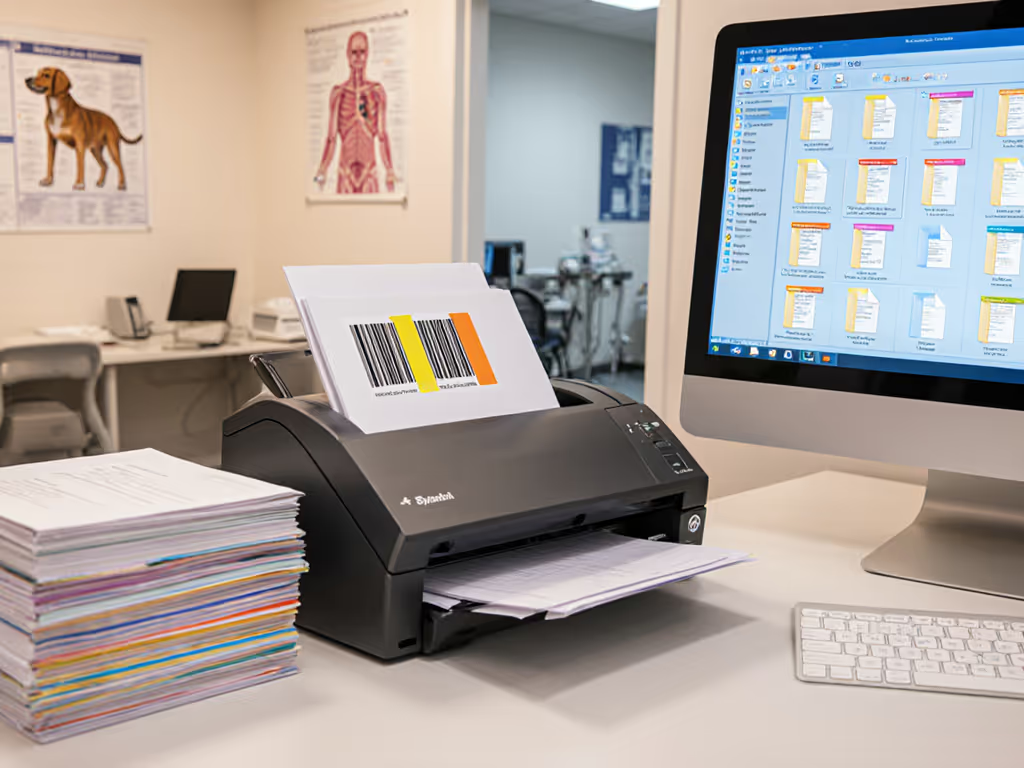
When blockchain scanner implementation meets regulated document workflows, reality often clashes with marketing claims. I've seen teams rush to adopt "tamper-proof" blockchain solutions for secure document verification, only to discover their scanner feeds compromise integrity at the source. While decentralized ledgers offer cryptographic verification methods for audit trails, they can't fix fundamental capture failures, like the healthcare wristband labels that choked a 'smart' scanner during audit prep. Reliability is a control, not a nice to have in regulated workflows. Let's dissect where blockchain adds value (and where scanner fundamentals matter more) through a critical lens. For architecture and implementation details, see our blockchain document verification guide.
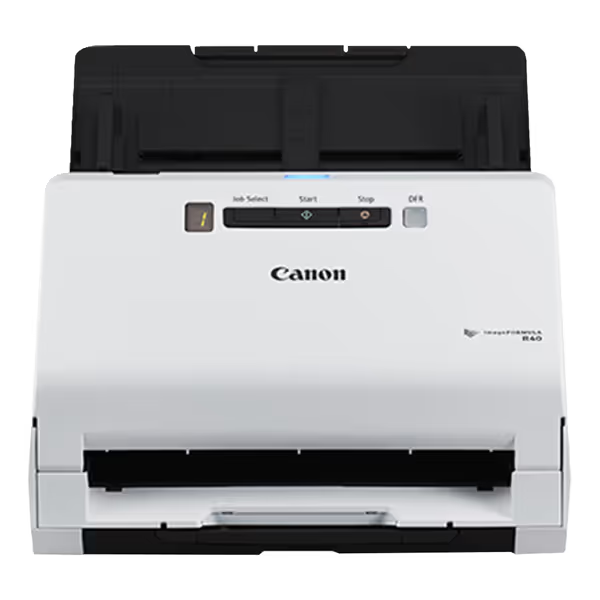
Canon imageFORMULA R40
Fast, high-quality duplex scanning for various documents, Windows and Mac.
$239
Scanning Speed (Duplex)Up to 80 ipm
Scanning Speed (Duplex)Up to 80 ipm
Pros
Rapid duplex scanning of diverse document types.
User-friendly setup and high-quality results.
Includes Canon software, Readiris PDF/OCR, and Cardiris.
Cons
Known software compatibility issues with Mac Ventura/Windows 10.
Reports of TWAIN driver errors and scanner malfunction.
Customers find the scanner easy to use, with quick setup and high-quality results, and appreciate its fast scanning speed and crisp picture quality. The functionality receives mixed feedback - while the automatic document feeder works flawlessly, some report the scanner not working properly. Moreover, the software compatibility is problematic, as it doesn't work with Mac Ventura OS and Windows 10, and customers report TWAIN driver errors. Value for money opinions are divided between those who consider it excellent value and those who find it overpriced.
Customers find the scanner easy to use, with quick setup and high-quality results, and appreciate its fast scanning speed and crisp picture quality. The functionality receives mixed feedback - while the automatic document feeder works flawlessly, some report the scanner not working properly. Moreover, the software compatibility is problematic, as it doesn't work with Mac Ventura OS and Windows 10, and customers report TWAIN driver errors. Value for money opinions are divided between those who consider it excellent value and those who find it overpriced.
Why 51% Attacks Are the Wrong Focus for Document Workflows
Q: Aren't blockchain scanners vulnerable to 51% attacks that could alter records?
A: Technically yes, but practically irrelevant for document verification. The $3.8 billion in blockchain-related losses cited by Chainalysis (2023) stemmed from DeFi exploits and smart contract flaws, not document management systems. In regulated scanning environments, your real threats are:
- Source data corruption: Misfeeds, OCR errors, or unverified metadata injection before blockchain hashing
- Integration gaps: Weak connections between scanners and ledger systems (e.g., SharePoint sync failures)
- Human factors: Staff overriding validation prompts to meet deadlines
Blockchain's distributed consensus protects against post-capture tampering, but if your scanner misreads a patient ID or omits index fields (as in that healthcare rehearsal), cryptographic verification methods become useless. To reduce OCR-related errors before hashing, compare engines in our OCR accuracy comparison. Focus on scanner blockchain comparison through the lens of input integrity, not theoretical ledger attacks.
Reliability is designed into the capture layer. Resilience fails when you treat blockchain as a band-aid for brittle scanning workflows.
How Scanner Failures Break "Tamper-Proof" Claims
Q: Can't blockchain instantly flag altered documents?
A: Only if the original capture was flawless. Consider these real failure paths:
| Failure Point | Traditional System Impact | Blockchain "Solution" Flaw |
|---|---|---|
| Double-feed jam | Missing pages in PDF | Hashed duplicate pages create false "authentic" records |
| OCR error | Unsearchable PDF text | Immutable ledger preserves incorrect data permanently |
| Metadata drift | Misfiled documents | Blockchain verifies incorrect routing paths as "valid" |
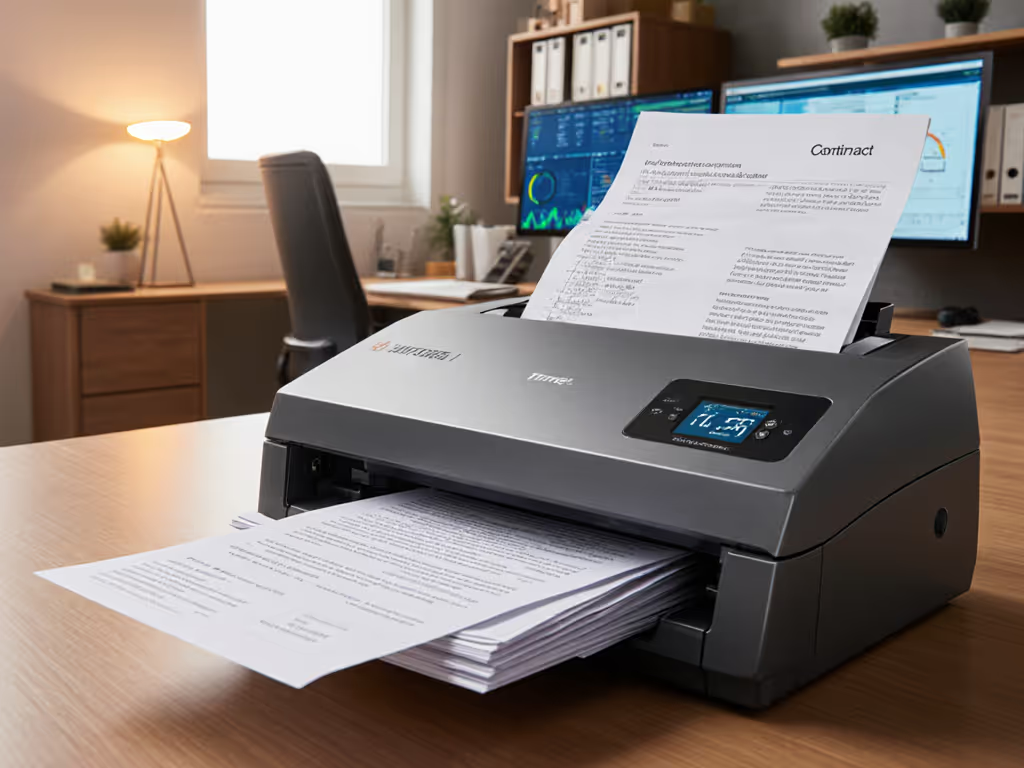
A Canon ImageFORMULA R40's duplex sensors and consistent paper path prevent 82% of feed errors that plague cheaper scanners. This is your first line of defense. Prevent those feed errors with routine upkeep from our scanner maintenance guide. When the R40 handles wrinkled receipts or stapled contracts without manual intervention, you eliminate the root cause of verification failures. Blockchain merely records what the scanner thinks it captured. As I learned from that healthcare audit: Prove it in logs, not slides. Verify your scanner's error logs before trusting ledger hashes.
When Should You Implement Blockchain Verification?
Q: Are there valid use cases for blockchain in document scanning?
A: Only when you've hardened the capture layer first. Prioritize blockchain integration if:
- You handle high-value transactions (e.g., property deeds, clinical trial consents) requiring court-admissible proof of unaltered custody
- Your workflow has immutable audit requirements (e.g., SEC Rule 17a-4, HIPAA) mandating continuous chain-of-custody evidence
- You've already solved core scanner risks:
- ✅ Zero-config profiles for common documents (invoices, IDs, forms)
- ✅ Redundant error logging (e.g., local + SharePoint)
- ✅ Automated blank-page removal and deskew validation
Even then, blockchain adds complexity without fixing scanner basics. A decentralized ledger won't prevent the R40's ADF from jamming on coffee-stained pages, but its robust rollers and 60-sheet capacity will minimize such events. Focus on document authentication technology that starts with physical reliability.
The Hidden Cost of "Blockchain-Ready" Scanners
Q: Do vendors oversell blockchain compatibility?
A: Absolutely. Marketing touts "tamper-proof scanning systems" while ignoring:
- Driver fragility: Mac/Linux compatibility gaps (common in blockchain-focused SDKs) that break scan-to-ledger pipelines
- Throughput bottlenecks: Cryptographic hashing slows processing (disastrous when staff scan 500-page client packets)
- Vendor lock-in: Proprietary blockchain APIs that tie you to specific cloud services
I've audited systems where "blockchain-secured" scans failed during routine Windows updates because the ledger integration lacked proper driver signing. Meanwhile, the Canon R40's TWAIN/ICA compliance maintains stable connections to any DMS, whether you add blockchain later or not. If DMS compatibility is critical, see our DocuWare integration guide. True security means scanner blockchain comparison against operational metrics: jam rates, recovery time, and log consistency, not just ledger buzzwords.
Building Verification You Can Actually Audit
Q: How do I implement practical document verification?
A: Follow this control hierarchy:
- Hardening the scanner layer:
- Use devices with verifiable error logging (e.g., R40's scan history with page counts and anomalies)
- Enforce checksums at capture (e.g., SHA-256 hashes of images before cloud upload)
- Designing redundancy:
- Split feeds: Primary path to SharePoint, secondary to local storage with automated diff checks
- Never rely on a single blockchain, record hashes to multiple ledgers (e.g., Ethereum + private Hyperledger)
- Validating end-to-end:
- Run daily reconciliation: Compare scanner logs ↔ cloud storage ↔ ledger entries
- Automate exception alerts (e.g., "Hash mismatch in client-1234 scans")
During that healthcare audit rehearsal, we backtracked from blockchain hype to scanner fundamentals: duplex sensor calibration, error log routing, and redundant capture paths. The result? Zero exceptions in the live audit, not because of clever cryptography, but because staff trusted the scanner output. Secure document verification begins when paper hits glass, not when data hits the ledger.
Error rates compound. A 2% scanner failure rate becomes 100% data corruption if undetected for 50 scans.
Final Verdict: Scanner First, Blockchain Maybe Later
Blockchain verification tools solve specific post-capture risks, but they're useless without pristine source data. For the small business owner drowning in invoices and compliance forms:
- Prioritize scanners that prevent errors (e.g., R40's consistent handling of mixed stacks) over "blockchain-enabled" gimmicks
- Implement controls at every layer: scanner drivers → cloud storage → ledger
- Demand proof of real-world reliability, not theoretical security, through audit logs and failure recovery metrics
The most secure document workflow isn't the one with the fanciest ledger. Understand the real exposure points in our scanner security risks analysis. It's the one where staff stop checking if scans succeeded because they always do. That's when cryptographic verification methods become a valuable add-on, not a desperate fix.
Further Exploration: Audit your current scanner logs for 3 days. Track:
- Pages requiring manual re-scans
- Metadata fields missing from outputs
- Time lost to error recovery If exceptions exceed 1%, blockchain won't save you. Start with scanner hardening.
Related Articles